After having some time to think about whether or not I wanted to focus on David Lynch as my media niche for the second week in a row, I decided that I still think that I have a lot to learn from how he has really cemented himself as not only a filmmaker, but an artist in general. I’m not sure if I’ll continue to research him or choose another director or genre to focus on, but for now, I’m too intrigued by David Lynch.
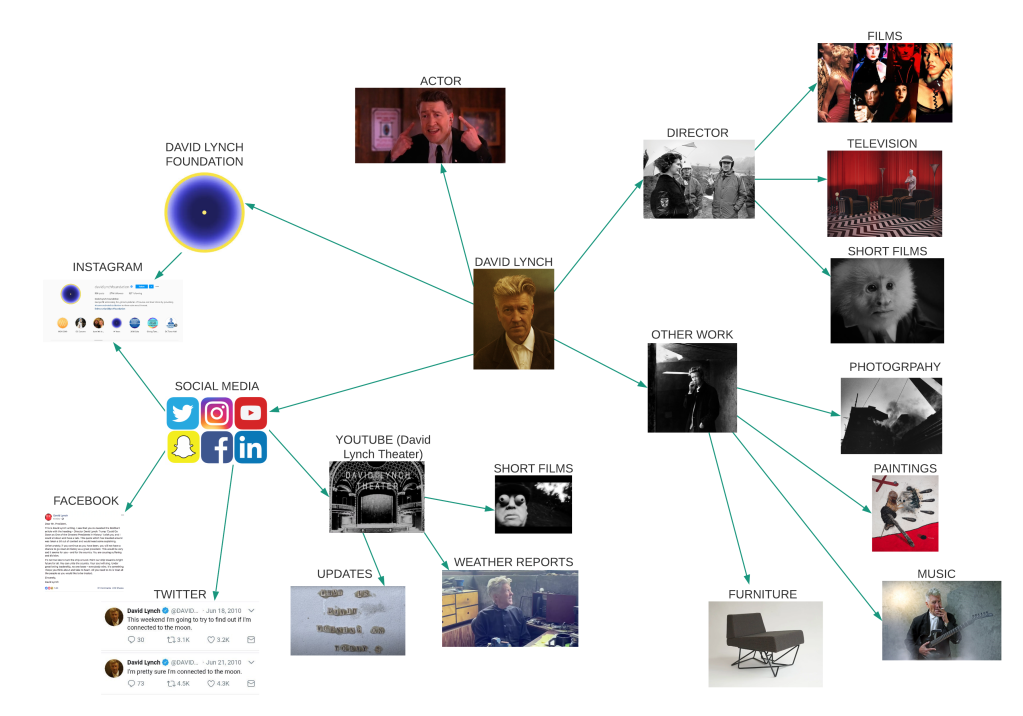
To understand the interest behind David Lynch as a niche, I’d have to construct a ‘field site’. The term ‘field site’ refers to the spatial characteristics of a field-based research project, the stage on which the social processes under study take place (Burrell, 2009). Constructing a field site of connections would let me be able to compare, contrast, explore and problematise, so I could begin begin to narrow down my research. The easiest way to go about mapping out the network of my field site would be to create a diagram.
After creating this diagram, I decided the best direction to focus my research on would be Lynch as a director. More specifically, to focus on Lynch’s directed Movies, Televisions episodes, and short films. This includes the content uploaded to his YouTube channel (David Lynch Theater). I chose to focus on him as a director as one, this is what he is most known for, and two, Film and TV is what interests me the most. I feel focusing my research on Film and TV will be helpful as I hope to pursue a career in the industry, and may help me to understand it better. By conducting an ethnographic research, I will hopefully be able to understand the appeal behind his work and his creativity, and not only understand the industry better, but maybe become more creative myself.
In my next blog I will begin to explore problematising this media niche and my approach to it, by outlining the key issues to help give a clearer understanding of the niche. At this moment I’m not sure how I will problematise this niche, so I will have to talk to lecturers and research more to get a better idea of how I might approach this and create a research question I can focus on.
Overall, I hope to create a Digital Artefact that will help me to understand the Film industry better, and extend my research to others also pursuing a career in it.
Burrell, Jenna (2009) ‘The Field Site as a Network: A Strategy for Locating Ethnographic Research’, Field Methods, 21:2, 181-199.
I’ve loved Movies for as long as I can remember, and learnt at a young age that the backbone of these movies are the directors. Throughout the years I’ve constantly been entertained and inspired by filmmakers and the passion they put into their craft. As a child I was in awe of works from greats like Steven Speilberg, Ridley Scott, and James Cameron. In my teens I gravitated towards the stereotypical film students favourite directors like Quentin Tarantino, Martin Scorsese, and Stanley Kubrick. And now in my twenties, I watch A24 movies exclusively and nothing else. All jokes aside, when asked to choose a Media Niche, I wanted to choose a director whose body of work is wholly unique and loved by their fans, but is also somewhat divisive. The first director that comes to mind for me would be David Lynch.
King
At first, Lynch’s work wasn’t really something I was fond of and couldn’t see why his fans made such a fuss about him. His movies never gave clear explanation for things that took place within them and at the time of watching them, it frustrated me. But over the years his movies started to really grow on me. Every time I re-watched one, I found something new in them, and enjoyed the fact that he left the interpretation completely up to the viewer. Slowly I started to realise why the man literally has a genre named after him. This genre usually follows Lynch’s style of mundane life juxtaposed against the grotesque, surrealism and defying clear explanations. I think that this is why people are so drawn to his work. His movies aren’t easy watches and require full attention, and not to be watched with expectations on where the story is going or how it will turn out. A lot of his movie have scenes that are totally bizarre and don’t make sense, but leave it up to the viewer to make their own sense.
Lets take Twin Peaks for example. A satire of soap operas about a murdered homecoming queen and the following investigation. The show drew in 35 Million viewers for its pilot episode. But as the series went on the episodes got more surreal and the ratings dropped as a result. Although the ratings dropped, the show is now seen as a cult classic. Twin peaks is what really bought David Lynch into the spotlight. Nothing like twin peaks had ever been shown on TV before, It was dark, quirky, realised, surreal and was the first truly cinematic series.
David Lynch is almost like a character pulled straight out of a David Lynch movie. Speaking in the most sincere terms, hes a complete madman. Not only is he a filmmaker, but a painter, musician, Actor, and furniture maker. He’s such an interesting and original character. And I think by giving a more in depth analysis of Lynch as a person and artist, his movies, viewers reactions and opinions on them, we can begin to understand why Lynch’s work is so captivating for many people.
When asked to create a Digital Artefact I wanted to explore something I both was interested in and knew quite well.
Concept
So for my Digital Artefact I chose to base my idea around Movies. I brainstormed ideas and ways I could integrate movies and how i could talk about them into my Digital Artefact and ultimately decided on making a Youtube Channel. I was mainly taking inspiration from youtubers I enjoyed watching like Internet Historian and NakeyJakey, and wanted to emulate what they were doing in their videos. With Film as the main focus of Digital Artefact I created MovieTalkMedia, a youtube channel that would review movie and talk about different aspects of them. I also didn’t want YouTube to be the main focus of my DA, so I also created a Letterboxd account where I would post reviews before uploading them as a video on YouTube.
Methodology
So with my plan set out, I started to set the project in motion by creating content. I Posted my first review for Parasite (2019) on Letterboxd where I slowly started gaining followers. After the review on Letterboxd I took the review and turned it into a script that i could use for a video. I then went out and brought a lapel microphone that I would need to make my videos with. After my setup was complete I began work on my first video which consisted of me taking trailer footage and playing it over audio of me reviewing the movie. After uploading my first video on YouTube I took to reviewing more movies on Letterboxd where i was gaining more followers each review I put up. I then finally uploaded my second review for The Last Black Man in San Francisco.
Utility
So the utility of my Digital Artefact was to give users my opinion on movies that ive seen and enjoyed. I tried not to review any mainstream movies and kept mostly to indie movies as I enjoy talking about them more. Movies and the film industry is also my biggest interest and the industry i wish to work in. So while reviewing movies and talking about them is something I’m passionate and enjoy talking about, it also helped me gain more knowledge on the industry I want to work in.
Reflection
When reflecting on where I first began with my Digital Artefact I’m happy with where its come. Although my YouTube channel hasn’t reached the success I would have liked, My Letterboxd account has done pretty well. I think the main reason why my YouTube channel hasn’t had much success is because I haven’t uploaded enough content and because I haven’t been engaging with audiences.
Conclusion
In conclusion, I think that making more content on YouTube and engaging more with audiences could have led to a more successful Digital Artefact. All in all though, I enjoyed making content on something that I was interested in and had a lot of fun with this project.
My Digital Artefact primarily focuses on film reviews. My reviews are uploaded to Letterboxd where I then turn that review into a script of sorts and record audio of me reviewing that movie. I then edit the audio over clips of the movie and upload it to YouTube.
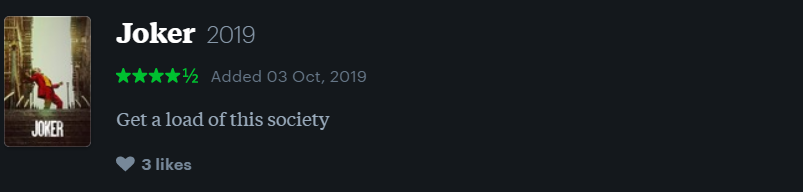
The making process of my digital artefact has consisted of me creating content for both Letterboxd and YouTube. I have five reviews on Letterboxd. Those reviews being Parasite, The Last Black Man in San Francisco, The Joker, Once Upon a Time… In Hollywood, and Midsommar. I Currently have just over 50 followers on Letterboxd. I also have two video reviews up for Parasite and The Last Black Man In San Francisco.
Although I enjoy making content for my YouTube Channel, It hasn’t reached the success I would have liked it too. I think this is due to a number of reasons. The first and main one being that I haven’t engaged and pushed my brand out to audiences ie. Twitter and #BCM114, And that i haven’t been consistent with uploading content on my channel. Although my YouTube Channel may not have reached the success I hoped for, my Letterboxd profile hasn’t done too bad. As i said it currently sits at 50 followers and usually get a number of likes of my reviews. I think this is due to more content and more engagement with Letterboxd compared to YouTube, and also the fact that my audience on Letterboxd have a common interest for movies and are more likely to engage with my content.
When reflecting on where I first began with my Digital Artefact I’m happy with where its come. In hindsight though i think that making more content on YouTube and engaging more with audiences could have led to a more successful Digital Artefact. I put quite a lot of effort into making the videos for YouTube but will use this as a learning experience on how important it is to engage with audiences.
My Digital Artefact primarily focuses on film reviews. My reviews are uploaded to Letterboxd where I then turn that review into a script of sorts and record audio of me reviewing that movie. I then edit the audio over clips of the movie and upload it to YouTube.
So far I have five reviews on Letterboxd. Those reviews being Parasite, The Last Black Man in San Francisco, The Joker, Once Upon a Time… In Hollywood, and Midsommar. Currently I’m sitting at 32 Followers on my Letterboxd account and is usually were I get feedback.
I also currently have a video review up for Parasite on YouTube. Right now I’m in the middle of editing my video review for The Last Black Man in San Francisco. Here are some photos of my progress so far.
I’m also in the middle of writing the script for my video reviews of both Joker and Midsommar which will be released within a few days of each other and just after the release of my video review for The Last Black Man In San Francisco.
I think it’ll be interesting to see which reviews do better considering i’ll be reviewing Joker which is a considerably larger movie than the others I have reviewed and will be reviewing. Depending on how well it does I might branch out to more mainstream movies and start reviewing them as well as smaller indie movies.
Like I said Previously Id like to make a video that isn’t a standard film review. Exploring a topic of film or an older film I really appreciate and coming at it from a different angle rather than just reviewing it, I think would be really interesting. An Essay structure would probably what I’d go for. Twitter is also something that I need to start engaging more with and asking people what movies they want me to review or their opinions on the latest movies. During the making stage of my digital artefact I hope to have at least four videos out and be in the process of making an essay type video.
I think that At the moment its hard to tell what kind of content my audience on YouTube are interested in seeing having only one review out, but once I finish and release my other reviews i can decide what type of movies my audience are more interested in seeing reviewed. I also need to engage more with audiences and push my content out to more platforms like twitter to get a bigger reach and have my content noticed.
This is the project Beta for my Digital Artefact for BCM114. My Digital Artefact focuses on video Film reviews and is primarily centred around a YouTube. Although I also review movies on Letterboxd before making a video review of it.
I didn’t mention this in the video because I didn’t have enough time. Although I say in the video that I want the channel to be primarily focused on reviews, but I’d still really love to do a more essay structured video and talk about a movie I find really special and dear to me, or even talk about the internet’s reaction to a movie. Its kinda what my whole idea was going into creating my Digital Artefact, and while the channel will still be focused mainly on reviewing movies, I would still love to make a video like that. Just kinda depends on the time and workload I have.
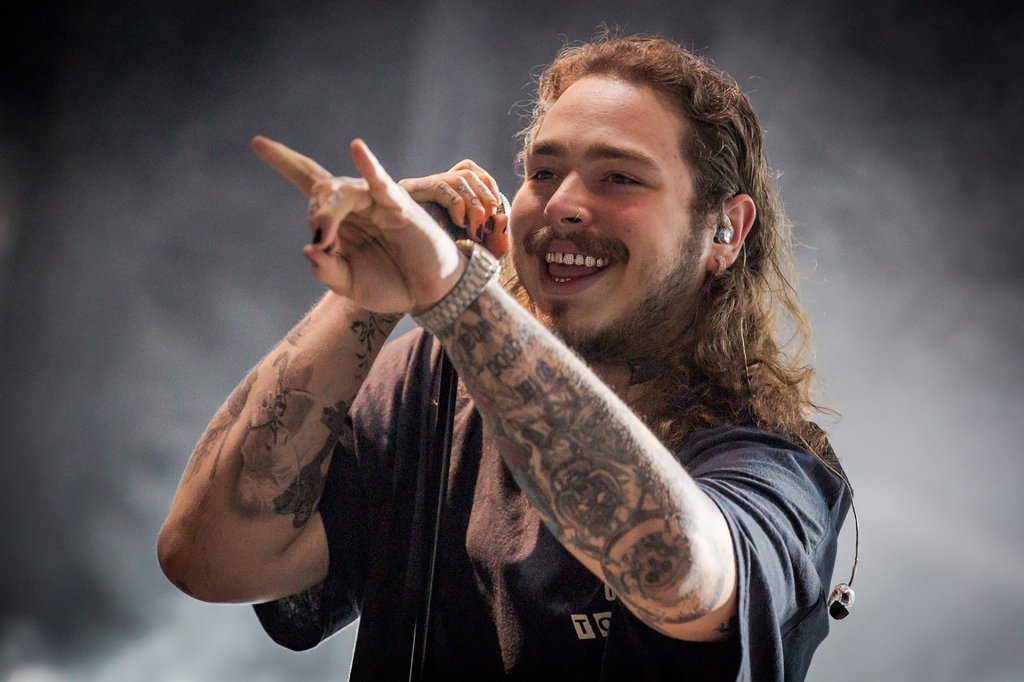
Just to clarify, I’ve never really been a huge fan of his music, but Post Malone is one of the biggest names in the music industry today. His music has accumulated over 1 billion views on YouTube, 50 millions monthly listeners on Spotify, and constantly sells out arenas across the globe. Although with his success, Austin Post on numerous occasions, has been labelled as a ‘culture vulture’ and that he culturally appropriates African-American and hip hop culture.
But what is Cultural Appropriation?
“Cultural appropriation refers to the ways people adopt or adapt an aspect of another’s culture and make it their own (Heyd, 2003; Hladki, 1994).” (Han, 2019). This is often considered a problem today as people believe “When the dominant group continues to steal aspects of the non-dominant culture, it continues the economic oppression and disadvantage of that culture.”(Reachout, 2019).
So why is Post Malone labelled a Culture Vulture and often accused of Culturally Appropriating?
When it comes to Post Malone, People often accuse him of culturally appropriating Hip-Hop culture. Post often receives this criticism for several reasons. Being a white american rapper who wears braids. He allegedly doesn’t invest anything back into the hip-hop community. But the most controversial being a statement he made during an interview with NewOnce “If you’re looking for lyrics, if you’re looking to cry, if you’re looking to think about life, don’t listen to hip-hop. There’s great hip-hop songs where they talk about life and they spit that real shit, but right now, there’s not a lot of people talking about real shit. Whenever I want to cry, whenever I want to sit down and have a nice cry, I’ll listen to some Bob Dylan. Or whenever I’m trying to have a good time and stay in a positive mood, I listen to hip-hop. Because it’s fun. I think hip-hop is important because it brings people together in a beautiful, happy way.” (Zisook, 2017). A large portion of the Hip-Hop community took a lot of offence towards this statement. In an article titled, ‘Here’s Why Post Malone Is a Problem‘ from Complex Magazine, Shawn Setaro writes “This shows a stunning level of ignorance about black music and culture (and, by extension, the people who make it). If you can’t find hip-hop that makes you want to cry or think about life, you’re either not looking very hard or you’re listening in a way that precludes you from hearing any emotion you can relate to. It’s hard not to see either as anything but racialized dismissiveness.” (Setaro, 2017)
My opinion
Now I can definitely see how in some cases cultural appropriation can be considered very problematic. But in the case of Post Malone I can’t say that I agree with it. Regarding the statements that he’s apart of the Hip-Hop culture but doesn’t invest or do anything to further the evolution of Hip-Hop, I think is a very opinionated thing to say. I argue that plenty of people would argue the complete opposite and say that he blends different genres together to create a unique sound that can be identifiable as Post Malone. I read an article from odyssey that said something I, and I think a lot of others can agree with. “While Post’s career has excelled because of his rap, he’s shown a great interest in other genres and includes a wide variety of genres and genre-mixing in his work.”(Wittorp, 2018). Combining all of these genres lead to more creative projects and I think that’s a big part of why I don’t really see why it’s such a big issue in this case. Like I said i’m not really even a fan of his music, but he’s obviously inspired by different genres and trying something new. Regarding the statement he made about Hip-Hop, I think that a lot of people took that out of context and only saw “If you’re looking for lyrics, if you’re looking to cry, if you’re looking to think about life, don’t listen to hip-hop”. He never said that Hip-Hop is void of any of these things. He’s just saying that today’s Hip-Hop is filled with a lot of rappers talking about the same themes eg. Money, women, fame, violence etc. He followed up saying “There’s great hip-hop songs where they talk about life and they spit that real shit, but right now, there’s not a lot of people talking about real shit” straight after. A lot of headlines and people criticising Post only chose to show one part of what he said instead of letting him explain himself. So do I think Post Malone is a Culture Vulture? No. But this doesn’t mean I don’t understand or empathise where others are coming from.
I know people might not agree with my opinion on the matter but I’d love to discuss this issue with others as its something I find very interesting and have a lot more to say about the topic. So I’d love to hear your opinion and thoughts.
Korean Director Bong Joon-ho has created some of the most interesting and well thought out movies to come out of South Korea since his feature film debut with Barking Dogs Never Bite. But his next movie Memories of Murder, was what made him a director to keep an eye on. He proved over the next few years that his first two films weren’t just a fluke with Mother, The Host, Showpiecer, and Okja (Snowpiercer and Okja being his most recognised and popular works as they were directed in English). His latest film, Parasite, is making major waves within the film industry, with critical success and even nabbing the Cannes Palme d’Or at the Cannes film festival, (One of the most impressive awards to win in film) beating out Quentin Tarantino’s Once Upon a Time in Hollywood. With this movie, it’s quite easy to see why Bong Joon-ho’s Korean speaking movies are a lot more critically successful than his English speaking movies. But I think that the best way to experience this movie is without knowing anything about it.
(Minor story spoilers)
The story of Parasite revolves around Ki-taek’s struggling family in South Korea who are all unemployed. When an opportunity arrives for his son to teach an extremely wealthy family’s daughter how to speak English, the rest of the family create a facade to obtain jobs within the wealthier family’s house, but eventually find themselves entangled in an unanticipated incident.
Written and Directed by Bong Joon-Ho himself, This movie evolves into something so gripping and unusual. While this would be seen as a thriller by many, its also a dark comedy. This can often be seen as quite dangerous as to many tones can often leave an audience confused and disengaged. It also plays to audiences expectations only to then completely subvert them when you think you know whats going to happen. Parasite executes this all of these elements amazingly through Bong Joon-Ho’s incredible direction and writing. Society and economic backgrounds, and family are the three most common themes of Parasite, Although nothing gets lost in translation and explains everything the audience needs to know culturally to understand it. The themes that Parasite is exploring really hit home by the end of the movie and takes us to some unexpectedly emotional resolutions of character arcs. The cast which consists of Woo-sik Choi, Hye-jin Jang, So-dam Park and long term collaborator Kang-ho Sang, are all at the top of their game here, with an especially phenomenal performances by Kang-ho Sang. Cinematographer Kyung-pyo Hung returns with might be his best work yet. The sound design is great and the score fits perfectly and helps add to the tension of the movie. All of these elements combine to make an incredibly satisfying movie, while also being highly re-watchable. When introducing someone to foreign language movie, this would be one the first i’d recommend.
“A small league of heavyweight countries dominates the export of film and television programs to the import markets of other countries, whereas the latter have only a featherweight trade capability or none at all.” (Fu, 2006). This statement relates to Cultural Homogenisation, which is the concept that the culture of richer countries (eg America and Hollywood) are perceived to be of superior quality. Korean Cinema has become increasingly popular over the past few years. Movies like Oldboy, I Saw the Devil, Mother and The Wailing have all gained well deserved recognition and positive reactions from western audiences and critics. All of these movies are insanely good and in some ways, surpass most Hollywood movies. Parasite being another example. Its quality is proven by the reception of audiences, critics and film academies, and as stated previously, even won the Palme d’Or at the Cannes film festival. The stigma that Hollywood creates superior work compared to other countries is ridiculous, and is often proven wrong, and Parasite definitely proves this.
“Ideas are important because they are the source of every aspect of human endeavour. Our potential is only limited by the ‘quality’ of our ideas.” (Graham & Bachmann2004)
The idea-
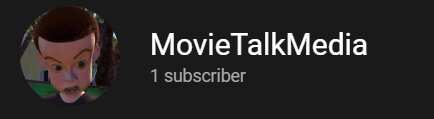
I believe I have a lot of knowledge about one subject and one topic only, and that topic is Movies. Every other topic i’m a little bit small brain. So when I began BCM114 I immediately knew I wanted my Digital Artefact to somehow incorporate movies. And what better way to talk about movies than by making a YouTube Channel. So I decided to create MovieTalkMedia.
Its not much, but its honest work
The main idea for the channel at the start was just simple movie reviews, but after brainstorming and taking inspiration from other YouTubers, I decided I wanted the channel to be more than just reviews. Looking at YouTubers like Internet Historian, Supermega, and NakeyJakey helped me to ideate the incorporation of not only reviews but stories and conversations surrounding the film industry. I also realised that sitting in front of a microphone and talking about what I liked or disliked about a movie, or talking about movie related subjects would be incredibly boring. So I’ve decided to edit and structure my videos in a similar fashion to these creators.
Where I’m at now-
Before starting to produce any videos, I first needed to plan out how I was going to approach making one. I needed a recording device that was affordable and has clear audio. After doing some research and reading opinions and reviews, I decided to buy an Audio-Technica Lapel microphone.
Letterboxd film review for Parasite
After receiving feedback from my Tutor @angusVEVO, I decided to branch out to different platforms such as reddit, IMDB and Letterboxd. I currently have a review up on Letterboxd for Parasite(2019), and plan to post reviews there that I intend to make videos on. I hope to have another review for Once Upon a Time… In Hollywood up on Letterboxd next week. Then the week after have the video review up for it on YouTube.
I then created a script for my first video from my Letterboxd review and recorded the audio. I’m now currently in the middle of editing my first video review, which will be on Parasite(2019). The aim is to have it uploaded to my YouTube Channel by the end of next week. After the review is up, I aim to have a video uploaded every week.
Editing process for Parasite film review
Improvements
I’ve also been working on more research based videos which takes a lot longer than film reviews. I hope to have at least one of these videos every fortnight. Here’s a basic example of a video i intend to make about the internet’s reaction to the ‘Cats’ (2019) movie trailer.
A basic structure of the video and what I intend to research
Some other ideas that I believe will help me to achieve a more successful digital artefact include:
-Using Twitter to promote my channel more often
-Following more people on Letterboxd
-Starting threads on Subreddits asking people’s opinions on films I intend to review
-Creating a new channel picture and banner for my YouTube channel
Hopefully by fulfilling these additions , I’ll be able to create a more consistent and interesting Digital Artefact. Please feel free to comment feedback or suggestions below and if you’d like to keep up to date with my content, follow me on Twitter @mitchell_b24, or subscribe to my YouTube Channel: https://www.youtube.com/channel/UCIh28qrXMzWenpXnx4wWamg
Anime often gets a bad rep and is seen by many to be kinda cringe (its easy to see why). But like it or not Anime is huge. First making its way across from Japanese shores to western audiences with Astroboy in the 1960’s, Anime has had an enormous impact on western media with television series such as Dragon-ball Z, Pokemon and Naruto. These shows were and still are, global phenomenons. The popularity of these shows brought a major demand for more anime and demands were met. Although the quality of these shows varied. Although one in particular has always been classed as one that surpasses most anime, and breaks the stereotypes and cliches of the medium. That show is Cowboy Bebop.
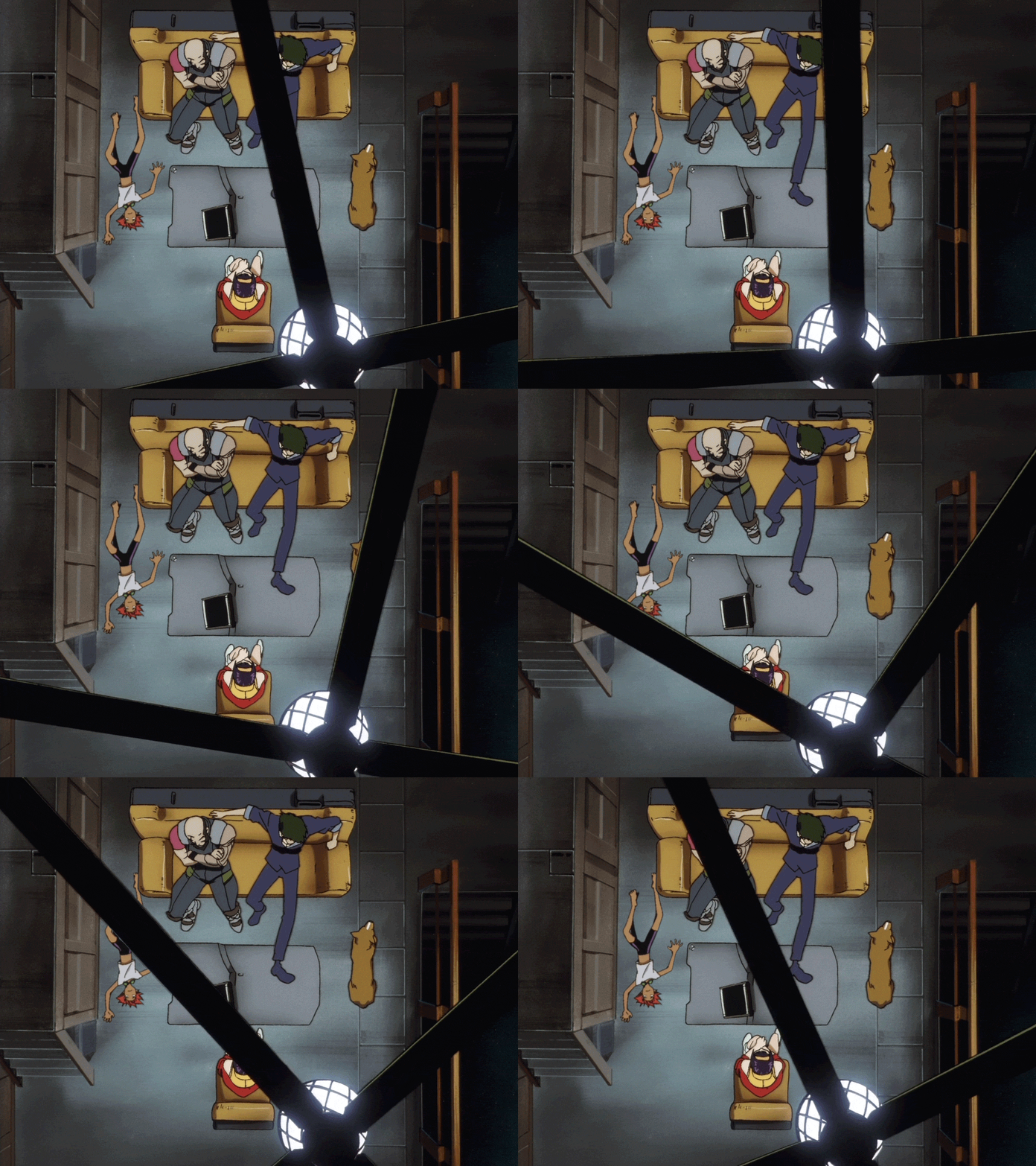
The show’s premise is set in a distant future where police have lost grasp on crime and a bounty hunting system has been implemented. We follow a group of bounty hunters (Spike, Jet, Faye, Ed, and Ein) who go on various adventures and try to cope with the struggles of their lives and their troubled pasts.
In the 20 years since its debut, Cowboy Bebop has been considered by many to be one of (if not) the best anime of all time, and is usually recommended as a great starting off point for anime. Actors like Robin Williams and Keanu Reeves (Who’s even tried to get a live adaptation produced with himself cast as Spike Spiegal) have expressed their love for the show. But why is Cowboy Bebop a global success?
There are many factors that contributed to the success of Cowboy Bebop (the soundtrack being a big one). One of them being the show’s style. The setting is otherworldly, yet has a sense of familiarity to most audiences. It does this by taking inspiration not only from Japanese culture, but western culture as well. Every episode is constantly brimming with pop culture references that range from music, literature, television, other anime, and cinema. Cinema being a major contributor to the shows style. Director Shinichiro Watanabe mixes genre of film that range from westerns like Desperado and A Fistful of Dollars, to science fiction such as Alien and Blade Runner to film noir like The Third Man, and even blaxploitation cinema, that all contribute to the shows characteristics. This hybrid of styles keeps things fresh and interesting in its short 26 episode series span. A quote from an essay written by Anthony Minghella on Cowboy Bebop’s style gives a great example of what I’m saying. “a stylish blend of traditional Japanese anime with the sensibilities of American Westerns and the foreboding themes of 1930s film noir, set to a moody, often innovative jazz score.” (Minghella, 2006).
Watanabe chose this approach because he didn’t want to limit his work to one genre. By combining genres, themes and elements of particular works he enjoyed, he created a work that had something for everyone while also keeping the show original and enjoyable. For example, One episode titled ‘Toys in the Attic’, is a homage to Ridley Scott’s Alien and borrows heavily from the themes and structure of that movie. Its elements like these that made Cowboy Bebop such a success.
I think to sum up why Cowboy Bebop has been as successful as it is, is that it’s a love letter to pop culture. It combined elements from so many different mediums and created something totally original. One of the title cards for the shows pretty much sums up what i’m trying to say. ‘The work, which becomes a new genre itself, will be called… ‘Cowboy Bebop.’









 Mitch's blog